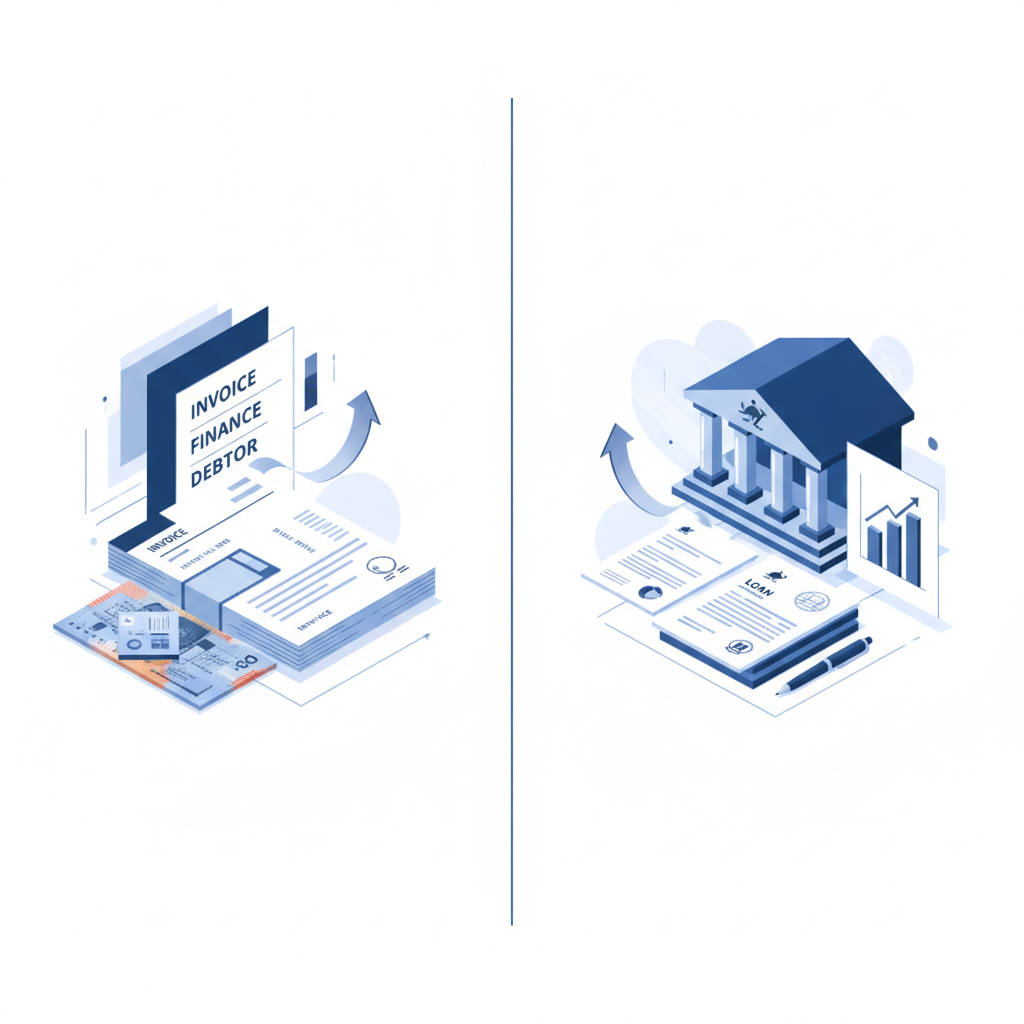
When your business needs funding, two of the most common options are invoice finance and a traditional business loan. But which one is right for you? In this guide, we break down the key differences so Australian business owners can make a confident, informed decision.
What Is Invoice Finance?
Invoice finance (also called debtor finance or accounts receivable finance) lets you unlock cash tied up in outstanding invoices. Instead of waiting 30, 60, or 90 days for clients to pay, a lender advances you up to 85–90% of the invoice value upfront. Once your client pays, you receive the remaining balance minus a small fee.
There are two main types:
- Invoice Factoring – The lender manages your debtor ledger and collects payments directly from your clients.
- Invoice Discounting – You retain control of collections, and the facility remains confidential from your clients.
What Is a Business Loan?
A business loan is a lump-sum amount borrowed from a lender and repaid over a fixed term — typically 1 to 5 years — with regular repayments. Business loans can be secured (using assets as collateral) or unsecured.
They’re commonly used for:
- Equipment purchases
- Business expansion
- Working capital top-ups
- Hiring staff or covering operational costs
Key Differences: Invoice Finance vs Business Loan
| Feature | Invoice Finance | Business Loan |
|---|---|---|
| Funding basis | Based on your outstanding invoices | Based on business financials & credit |
| Speed of access | 24–48 hours (once set up) | 1–5 business days |
| Repayment | When clients pay invoices | Fixed monthly repayments |
| Collateral | Invoices are the security | May require assets or personal guarantee |
| Flexibility | Scales with your sales volume | Fixed amount |
| Best for | B2B businesses with slow-paying clients | Capital investment or growth funding |
When Should You Choose Invoice Finance?
Invoice finance works best if:
- You invoice other businesses (B2B) on credit terms
- You have slow-paying clients causing cashflow gaps
- Your business is growing quickly and you need funds that scale with revenue
- You want to avoid taking on fixed debt obligations
It’s particularly popular with industries like construction, transport, labour hire, manufacturing, and professional services.
When Should You Choose a Business Loan?
A business loan is more suitable if:
- You need a lump sum for a specific purpose (e.g. equipment, fitout, or expansion)
- You operate in a B2C environment and don’t have business invoices
- You want predictable repayments and a clear payoff date
- You have strong financials and want competitive interest rates
Can You Use Both?
Absolutely. Many Australian SMEs use invoice finance for day-to-day cashflow management while also maintaining a business loan for capital investment. Using both strategically means you’re never short on working capital while still being able to fund growth.
What About Rates and Fees?
Invoice finance fees are typically charged as a percentage of the invoice value (0.5–3% per month depending on debtor risk and volume). Business loan rates vary widely — from around 6–7% p.a. for secured loans to 15–25% for unsecured facilities.
Always compare the total cost of funding, not just the headline rate. At Co-Pilot Finance & Insurance, we help you understand the true cost so you can make the right call.
Get the Right Finance for Your Business
Whether you need to bridge a cashflow gap or fund your next growth move, Co-Pilot Finance & Insurance can match you with the right solution. We work with a panel of leading Australian lenders to find you competitive rates with fast approvals.
Apply for business finance today or call us to discuss your options.